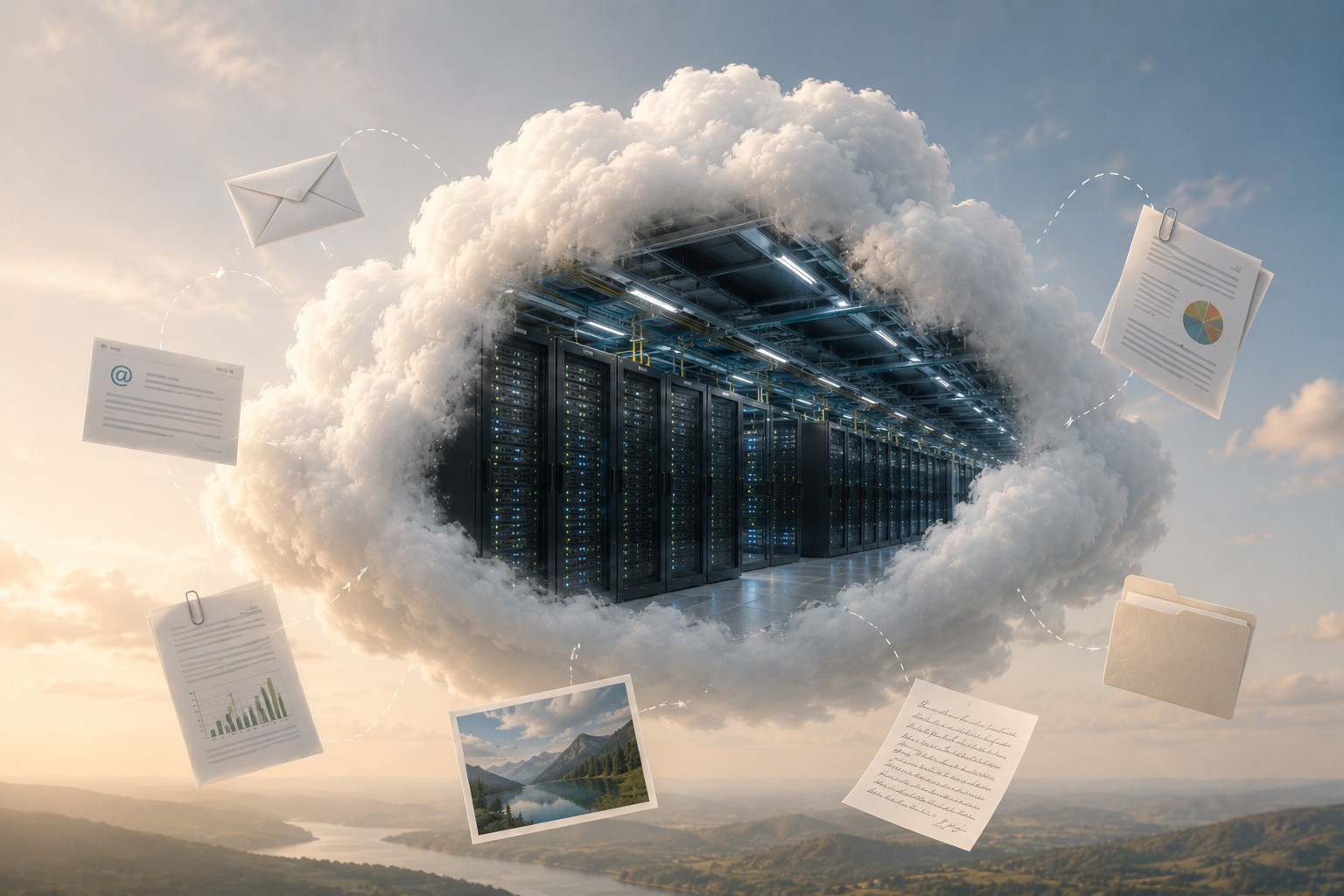
When people talk about “The Cloud”, it sounds wonderfully magical, doesn’t it?
It makes us think that our photos, emails and random screenshots are all floating peacefully around above us, living their best little sky lives!
Lovely idea, but sadly, it’s not true.
The Cloud is actually a network of enormous buildings packed full of computers.
Every time you:
- send or receive an email
- back up your phone
- stream a film
- save a photo
- upload files
- ask AI a question
- send a message
…you’re feeding “The Cloud”, and it’s always hungry!
All of that information has to live somewhere, usually in giant data centres run by companies like Google, Microsoft and Amazon Web Services.
Think of them as giant digital warehouses filled with rows and rows of powerful computers called servers, all humming away day and night.
And when I say day and night, I mean constantly.
No switching off.
No little nap.
No “I’ll deal with that tomorrow”.
Just endless processing while we innocently upload another blurry photo of the dog.
So why does this matter?
Because all of those servers use electricity.
A lot of it.
And then there’s the heat. You know how hot your laptop can get after an hour of use – now, multiply that by millions.
Servers get incredibly hot, so data centres need huge cooling systems to stop everything overheating.
So they need energy to:
- run the servers
- cool the servers
- keep everything running 24 hours a day
And as our digital lives grow, so does the demand.
More streaming.
More cloud storage.
More emails.
More “I might need this one day” screenshots.
It all adds up.
The bit most people never think about
Some people have 25,000+ unread emails.
Twenty-five thousand!
Honestly, just reading that number makes me want to lie down in a dark room for a minute.
But imagine if you printed all those emails out. Every email you have received, sent, filed and archived.
We’re talking piles of paper everywhere. Boxes stacked to the ceiling. Cupboards groaning under the pressure of newsletters from shops you bought one candle from in 2018.
And I haven’t even mentioned the downloads, photos, AI requests and Whatsapp messages.
You’d probably need a garage the size of a supermarket to store the lot.
That’s the strange thing about digital clutter.
Because we can’t physically see it, we assume it doesn’t really exist.
But all those emails, photos and forgotten downloads are still sitting somewhere on servers, quietly taking up space and using energy.
The Cloud is basically an invisible storage unit where many of us are hoarding digital junk we forgot existed three years ago.
And yes, I include myself in this.
At one point I found:
- 14 screenshots of my homescreen
- a photo of my carpet
- and six versions of a revolting passport photo
Apparently, I’m part of the problem too.
So should we all panic and throw our phones into a bush?
Absolutely not.
Technology is incredible and does loads of brilliant things.
It keeps us connected. Helps businesses run. Allows flexible working. Gives us access to information instantly.
And frankly, life would be much duller without videos of baby goats bouncing around in pyjamas.
This isn’t about guilt, but simply about awareness.
Once we understand that our digital lives have a real-world impact, we can make a few small changes without turning life upside down.
And honestly, most of them make life feel less cluttered anyway.
A Few Easy Tips To Get You Started
Change your email swipe settings from Archive to Delete – Most phones automatically archive emails when you swipe, which means they’re still stored in the cloud. Changing the setting to Delete makes clearing your inbox much easier – And surprisingly satisfying.
Iphone: Settings/Apps/Mail/Mail Accounts. Select your email account. Tap Account/Advanced/“Move discarded messages into”Deleted Mailbox instead of Archive Mailbox
Gmail app: Settings/General settings/Swipe actions – Change Left or Right swipe to Delete
Have a photo clear-out – Do you really need 27 nearly identical sunset photos? Delete blurry duplicates, accidental screenshots and photos you’ll never look at again.
Unsubscribe from emails you never read – like the regular ones from a company you bought one thing from five years ago. A quick unsubscribe session can massively reduce inbox clutter.
Stream a little more mindfully – Streaming in ultra HD uses more energy than many people realise. If you’re only half watching while scrolling your phone and folding washing, standard definition is probably absolutely fine.
Empty your recycle bin – Deleting files isn’t always the end of the story. Many devices quietly keep them sitting in the recycle bin or “recently deleted” folder for weeks, which is basically the digital equivalent of putting rubbish next to the bin instead of in it.
Delete old downloads – Take a brave look inside your Downloads folder. You’ll probably find:
- PDFs you opened once in 2021
- screenshots you forgot existed
- random forms
- AI images of you as a muppet
- something called “Document(7)-FINAL-v2”
If you don’t need it, let it go.
Delete apps you never use – We all have them. Apps downloaded during one ambitious phase of life:
- Couch to 5K
- language learning
- meditation
- plant identification
- “learn guitar in 7 days”
If you haven’t opened it in months, it’s probably safe to say goodbye.
Don’t forget your Sent and Spam folders – People often clear their inbox… and completely ignore the other folders quietly hoarding thousands of emails in the background. Your Sent folder can be huge, especially with attachments, and Spam folders are often full of absolute nonsense that nobody needs to preserve for future generations.
Tidy your cloud storage – Old backups, duplicate files and mystery folders all take up storage somewhere.
A little digital declutter every now and then genuinely helps, And honestly? It makes your brain feel calmer too.
Make it a weekly habit
You don’t need a full weekend “digital detox”.
Just five or ten minutes once a week can make a massive difference.
Pop the kettle on, put some music on and have a quick digital tidy-up.
Future You will be delighted and the planet will thank you too.
Don’t aim for perfect
This isn’t about becoming some ultra-minimalist who owns three possessions and lives off the grid in a yurt.
It’s just about being a bit more mindful.
A few small habits really do add up.
And if you currently have 25,000 unread emails…
This is your sign.
Small digital habits can make a difference too. Why not spend ten minutes today clearing old emails, downloads or screenshots?
0 Comments